
Undulating mud brick walls in Egypt with alternating concave and complex sections - aesthetic or structural? Auguste Choisy thought it was a design feature to counter shrinkage and settlement (Beiersdorf, 2015). Credit: Lea Rees.

Isambard Brunel on his design for Clifton Suspension Bridge in 1831: "Of all the wonderful feats I have performed, yesterday I performed the most wonderful. I produced unanimity amongst 15 men who were all quarelling about the most tickish subject - taste. The Egyptian thing I brought down was quite extravagantly admired by all - unanimously adopted and I am directed to make drawings." Credit: Clifton Suspension Bridge Museum
An introductory video on the world's first effective testing machine for construction materials by David Kirkaldy. His pioneering research on the tensile strength of wrought iron and steel is accessible here and the machine is housed in a museum in London.
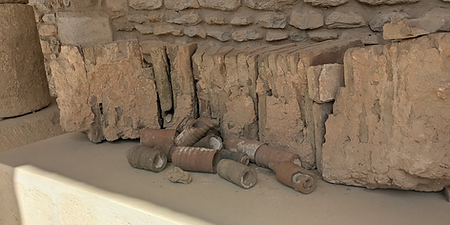
Tubi fittili are baked clay tubes used in ancient Roman architecture (particularly in North Africa and the Iberian peninsula) to build temporary formwork for masonry arches, vaults, and domes of different geometric forms (i.e. semicircular, elliptical, etc.). The tubes are wide at one end and narrow at the other end. Builders fit the narrow end of one tube into the wide end of the next. The tubes feature grooves made on the pottery wheel to improve the adhesion of the mortar that is filled inside the tube.